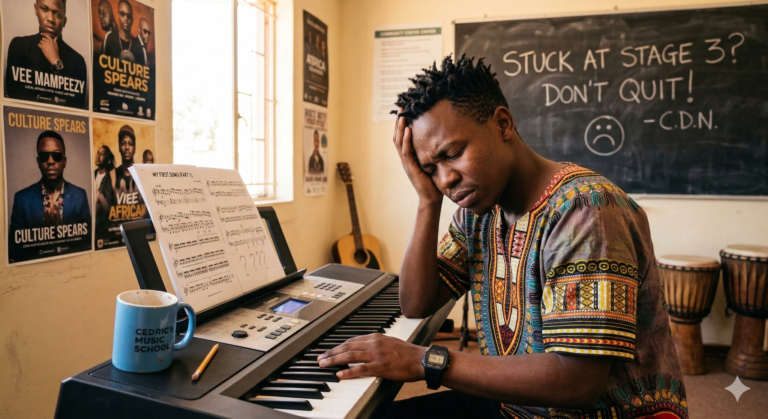
Raise your hand if this sounds familiar: You (or your child) absolutely love music. But the music coming out of the headphones is pulsating Kwaito, distorted Punk Rock, or perhaps some hyper-fast Japanese Jazz-Fusion. And the music on the piano music stand? It’s… well, it’s Mozart. And it feels a bit, let’s say, ‘stuffy’ by comparison.
This is a classic musical crossroads, and it’s where many students mistakenly believe they have to choose a side. They think, “I love this kind of music, so this other kind of music must not be for me.”
As a music teacher, I’m here to tell you that this is a total myth. In fact, those two ‘sides’ can be the best of friends.
I once had a student—let’s call him Thabo—who lived for punk rock. He wore band t-shirts every day, his hair was a gravity-defying sculpture, and he lived to play fast. When he first started classical piano lessons, he looked like he’d rather be having a tooth pulled. The polite, disciplined world of Baroque sonatas felt completely alien to him.
“This is boring,” he’d sigh, staring at a simple Minuet. “Where’s the energy?”
Instead of trying to make Thabo conform to a rigid idea of a “classical” student, we leaned into his inner punk rocker. I challenged him: “You think this piece is boring? Then don’t make it boring.“
We took that same Minuet, which was traditionally played with gentle grace, and we treated it like a punk anthem. We attacked the keys. We emphasized the syncopated rhythms. We made it loud. We made it aggressive.
Suddenly, Thabo wasn’t just playing notes on a page; he was channeling his own musical expression. And a funny thing happened. As he got more comfortable bringing his own energy to the classical pieces, he started to appreciate the inherent energy within them. He realized that a Bach fugue has a complex, driving momentum that any good metal band would envy.
The lesson here isn’t about changing classical music. It’s about changing how we listen to it.
Your personal musical taste isn’t an obstacle; it’s your superpower. Learning a ‘proper’ instrument like the piano or violin gives you the technical tools and discipline to express yourself. When you bring your own genre-bending passion to your lessons, you don’t just become a good musician; you become a unique one.
So go ahead, let that inner punk rocker, rapper, or Kwaito star loose in your classical class. They might just teach you how to make Mozart rock.